
In lost foam casting, refractory coating is not a stand-alone station. The coating bath, foam cluster, dipping or other application method, drainage, and drying all have to work as one route. A mixer can be correctly sized on paper and still create a bottleneck if clusters cannot be moved safely, excess coating has nowhere to drain, or the drying area cannot accept the next batch.
That is why a useful equipment review starts with the pattern and production route, not with a machine name. This guide covers the questions a foundry should settle before planning refractory coating handling for lost foam casting. It focuses on process interfaces and project inputs; it does not prescribe a coating formula or replace the coating supplier's process instructions.
Map the route before selecting equipment
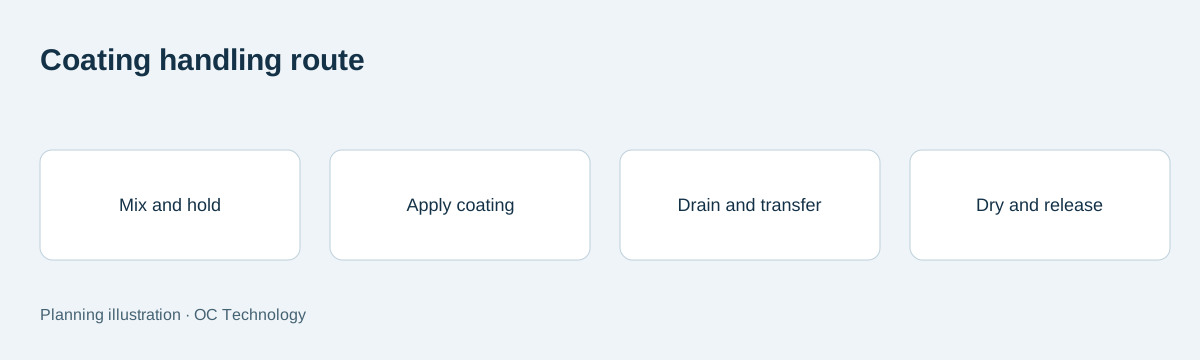
Write down the actual sequence from coating preparation to the point where a dry coated cluster is ready for the next operation. For many projects, that means checking these hand-offs:
- Prepare and mix the coating, then keep it available for application.
- Bring the foam pattern or assembled cluster to the application station.
- Apply the coating using the method selected for the pattern and coating system.
- Allow excess coating to drain and return or collect it as the process requires.
- Move the coated cluster to drying without damaging the wet layer.
- Release the dried cluster to the next production step.
The exact arrangement depends on the coating supplier's instructions, pattern geometry, cluster size, production rhythm, and plant layout. Treat each hand-off as a design question: who or what moves the cluster, where does it wait, and what must be ready before the next batch arrives?
Start with the coating and pattern information
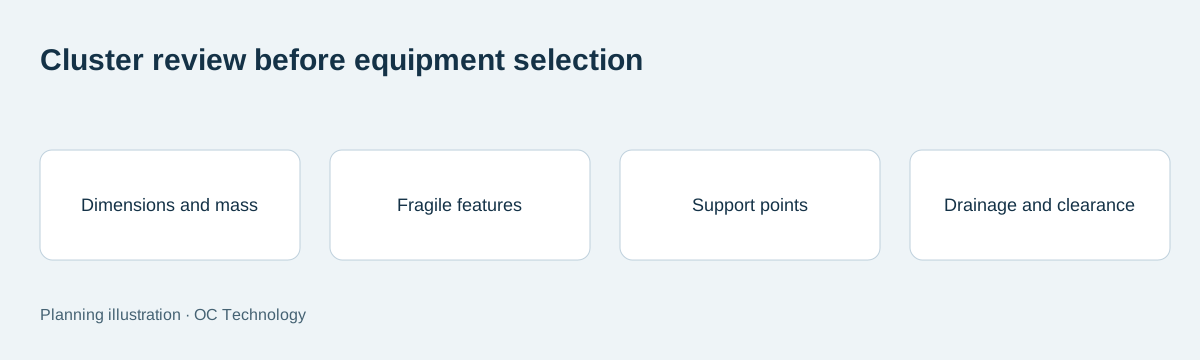
Before discussing mixer capacity or dryer dimensions, gather the information that determines how the material and cluster behave in the route. Ask the coating supplier which preparation, agitation, application, drainage, and drying conditions apply to the selected coating. Those values are material- and process-specific; equipment planning should not substitute generic settings for the supplier's instructions.
For the patterns, record the largest and heaviest individual pattern and cluster, the number of patterns per cluster, fragile projections, openings or enclosed areas, and surfaces that are difficult to coat or drain. Include representative drawings or three-dimensional files where available. A single overall dimension rarely describes handling needs well enough.
Also clarify the expected batch sequence. How many clusters are prepared together? How often does a new cluster reach coating? Does the product mix change during a shift? These answers influence the number of holding positions, transfer method, and buffer space between application and drying. They do not, by themselves, establish a guaranteed line output; the full route and operating assumptions still need review.
Plan mixing and temporary holding together
Coating preparation and application are linked by the time between them. The foundry and coating supplier should define how the material is mixed, whether it must remain under agitation, what checks are made before use, and how material is handled during a pause or changeover. The equipment review can then address the practical questions: where mixing takes place, how the prepared coating reaches the application station, how the vessel is accessed for cleaning, and how spills or wash water are managed.
Nominal volume alone gives an incomplete picture of a mixer. Compare the working batch, usable vessel space, access for adding materials, the required mixing arrangement, and the location of the dipping or application station. The right selection depends on the coating system and the supplier's process requirements. If material is shared across more than one station, include transfer and replenishment in the layout instead of assuming they will happen without interruption.
Temporary holding also needs a defined rule. A vessel that is idle, difficult to reach, or disconnected from the agreed agitation method can change how the team handles the coating. The operating instructions should state what happens during short waits, longer interruptions, and restart after a pause. These are process controls to agree with the coating supplier, not values that a machine brochure can establish.
Match application and drainage to cluster geometry
Immersion is one application method, but it is not automatically the best choice for every cluster. Before confirming the method, review how the cluster enters and leaves the coating, how it is supported, and whether the coating can reach the required surfaces. Consider the cluster's balance, fragile features, internal passages, and the space needed for safe movement around the station.
Drainage deserves its own step in the layout. The coated cluster may need a controlled position or a short holding period before it can be moved. Confirm where excess coating is collected, how the work area is kept clean, and whether the next cluster can be handled without interfering with the first one. The selected approach should follow the coating supplier's guidance and the foundry's quality checks.
Plan the drying hand-off and loading space
Drying is often where a seemingly balanced route begins to queue. Work backwards from the coating supplier's drying instructions and the foundry's release criteria. Then estimate how many coated clusters may be waiting at the same time, how they are supported, how operators load and unload them, and how air, heat, exhaust, and access are arranged for the proposed installation.
The equipment discussion should include the transition from a wet coated cluster to a dried cluster that can be moved. Confirm the permitted support points, clearance around the cluster, and whether the drying arrangement accommodates the largest geometry. Check the plant's available utilities and ventilation requirements with the equipment supplier and the site's engineering team. Do not infer a drying temperature, cycle time, or capacity from a generic article; these depend on the coating, pattern, loading, and agreed process.
Where production includes several pattern families, test the layout against more than the average cluster. The largest cluster may determine door opening and turning space, while a smaller but delicate cluster may determine the support arrangement. A useful review makes these cases visible before the dryer and handling route are fixed.
Keep the white-area and yellow-area interfaces clear
In project discussions, equipment scope should be mapped by operation. Pattern production and related handling belong to the white-area route; coating preparation, application, and drying form part of the yellow-area route described in the project brief. Sand filling, vibration, and pouring are downstream foundry operations and should be treated as interface points unless the project scope expressly includes them.
This distinction helps prevent gaps in responsibility. The layout should identify who supplies the cluster carrier, who defines coating acceptance checks, how the coated cluster is released to the next operation, and which utilities and civil works are provided by the plant. A process-flow drawing with equipment, operator access, buffers, and hand-off points is more useful for an initial review than a list of machine names alone.
Prepare a useful quotation brief
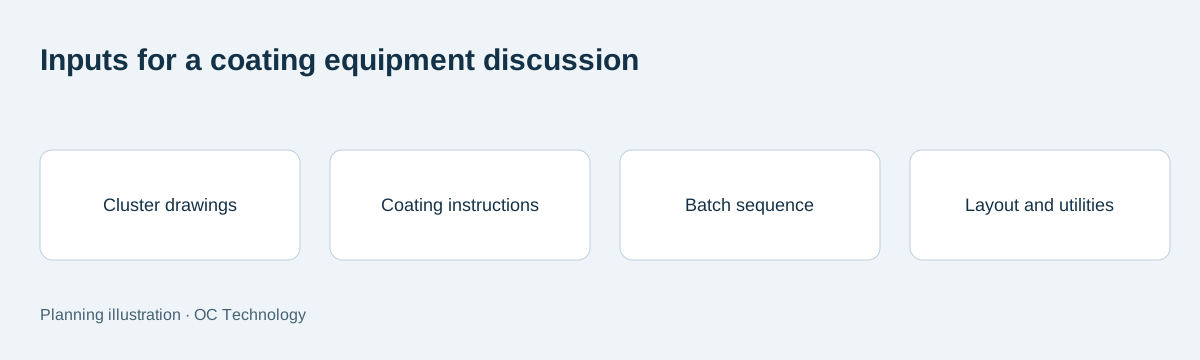
For an initial equipment review, prepare the following where available:
- Pattern and cluster drawings, maximum dimensions, approximate weights, and fragile or hard-to-drain features.
- The coating supplier's instructions for preparation, agitation, application, drainage, drying, and checks.
- Expected batch size, product mix, shift pattern, and the intended production sequence.
- A plant layout showing the proposed coating and drying areas, columns, doors, floor constraints, and operator routes.
- Available power, compressed air, water, drainage, ventilation, and any site limits that may affect installation.
- Existing equipment to retain, replace, or connect to, plus the planned project timing and delivery destination.
Open items can stay on the project brief until the relevant drawings or process information become available. A preliminary discussion can still identify the missing decisions and the route options that depend on them.
Questions buyers often ask
Is a dipping system suitable for every lost foam cluster?
Not necessarily. Suitability depends on the coating supplier's application instructions, cluster geometry, access to the surfaces, drainage behavior, and how the cluster can be supported and moved. Review representative patterns before selecting the method.
Can equipment selection determine the coating recipe or drying cycle?
No. The coating supplier and foundry process team should define material preparation, application checks, and drying conditions for the selected coating and pattern. Equipment selection should be based on those requirements and the plant's operating route.
What information is most helpful for a first project review?
Representative pattern and cluster drawings, dimensions and weights, the coating supplier's process instructions, expected batch rhythm, a layout, and available utilities provide a practical starting point. Open items can be listed for follow-up instead of being guessed.
Discuss the coating and drying route
Refractory coating handling for lost foam casting works best as a connected planning exercise: prepare the material, present the cluster, apply and drain the coating, move it safely, and make room for drying and release. The key decisions come from the actual coating instructions, representative pattern data, production rhythm, and plant conditions.
For a project review, share the cluster drawings, coating process information, expected batch sequence, and proposed floor layout. OC Technology can discuss coating mixing and dipping equipment alongside the pattern drying arrangement. Configuration depends on the coating instructions, cluster geometry and plant layout. To discuss the route and its interfaces, contact OC Technology.